
Simon has always had an interest in technology and innovation in orthopaedic surgery. He was an early adopter of computer-navigated surgery and has used it routinely for his knee replacement surgery for over ten years. He has been trained in robotic-assisted surgery in both Australia and the US and has published research on the use of the Verasense pressure monitoring devices used in total knee replacement surgery.
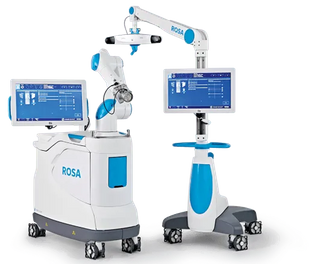
Robotic Knee Surgery
Using Computer or Robotic Navigation offers the following potential benefits:
- Better planning and modelling of your knee’s unique structure that enables a higher level of joint alignment accuracy
- A more precise fit, which optimises both range of motion and stability
There is also evidence to suggest:
- Less blood loss
- Less pain
- Shorter post-op rehabilitation
The early results in the joint registries for robotic surgery are very promising.
Computer Navigated Knee Surgery
Computer navigation provides the surgeon with the real-time 3-D images of the mapped patient’s affected joint and the surgical instruments during surgery. The data for the images is provided by the infrared sensors fixed to the bones of the joint and the surgical instruments.
Their position is tracked by an infrared camera placed above the surgical table connected to the computer. The computer then generates the real-time images with the help of the appropriate software to guide the surgeon to precisely resurface and cut the bones of the joint and fix the implant precisely & accurately according to the pre-operative surgical plan.
There is good evidence that this allows more accurate and precise positioning of the components and the hope is that this will lead to better function and longevity.